

Carbon monoxide (CO) system
Even a well-maintained car that has just been serviced has a CO-carbon monoxide gas emission of around 15,000 ppm. In poorly maintained vehicles, this value reaches 30,000 ppm. However, the limit CO value allowed in parking lots under today's conditions is 60 ppm. These values easily show us how high a risk the gas poses in a closed parking lot.
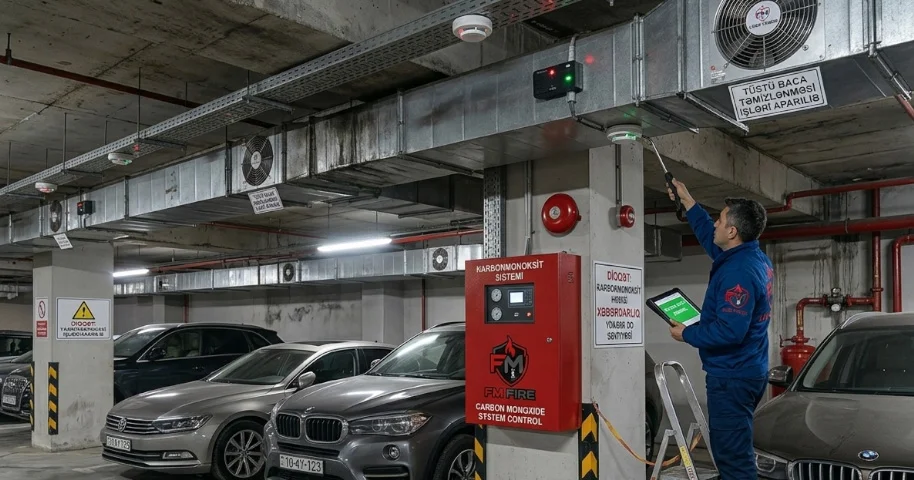
In the last few years, the creation of a CO gas intake system in closed parking lots and the introduction of automatic operation of ventilation fans by receiving signals from this system should be considered an indicator of this awareness. However, our consciousness, which perceives the problem and the solution with great sensitivity, postpones dealing with details such as technical infrastructure and standards aimed at implementation in this matter until after implementation.
As a result, a chaotic environment has been created where those who design the system, those who implement and have it implemented, and those who supervise it do not know what a system capable of achieving this very important goal should be, what basic criteria it should have, and how to control it.
This very basic article aims to provide a material that addresses the main issues related to gas, indoor car park ventilation and gas monitoring and control systems without going into details. Here, the guiding information on ventilation and carbon monoxide monitoring and control systems is based on the principles given in the German VDI2053 standard, which is the only regulation that is widely used in Europe today.
Taking into account the fact that carbon monoxide-CO gas is a guiding gas that will also ensure the evacuation of many of the harmful gases listed above and the lower CO gas emissions resulting from the use of catalysts in automotive technology, the previously applied maximum permissible limit of 100 ppm in a 15-minute average has been reduced to 60 ppm. In addition, it also proposes a peak value of 120 ppm in a 15-minute average and a peak value of 250 ppm without averaging, which has been applied for a long time, as alarm limit values.